

Regulating the Data Center Boom
Property-Rights, Stewardship, and Local-Control Case for National Rules
Why Rural America Cannot Be the Nation’s Unregulated Utility Yard
Chris Koch — CEO, Scope Technology LLC — Houston, Texas
Policy White Paper · May 19, 2026 · Prepared for legislators, commissioners, county judges, state policymakers, and rural stakeholders.
Core Thesis
A serious conservative approach to data centers is not anti-technology; it is anti-waste, anti-subsidy without accountability, and pro-property rights. If data centers want rural land, rural water, rural roads, and rural tolerance, then they must accept national baseline rules on water, noise, lighting, emergency response, fire safety, and waste-heat accountability. [1][3][4][5][6]
Disclaimer from the CEO
Scope Technology is a for-profit organization recognized as an industry leader in waste heat to power generation efficiency design and thermal technology. We recognize the critical importance of AI and data centers in supporting national and global security initiatives. As responsible Corporate American citizens, we are committed to advocating for collaborative approaches to environmental best practices for AI-Data center power generation and capture that promote mutually beneficial relationships with local communities, rather than simply imposing standards. Our objective is to ensure technological advancement supports both industry growth and the well-being of rural areas hosting these facilities through transparent communication and accountable stewardship.
Executive Summary
- The U.S. Department of Energy and Lawrence Berkeley National Laboratory report that data-center electricity use rose from 58 TWh in 2014 to 176 TWh in 2023 and could climb to 325–580 TWh by 2028, or roughly 6.7% to 12% of all U.S. electricity. This is not a light commercial load; it is industrial expansion on a national scale. [1][2]
- Brookings, WRI, EESI, and the National League of Cities all point to the same local consequences: water stress, land-use pressure, chronic industrial noise, light pollution, and strain on public services. These burdens are landing disproportionately in rural and unincorporated areas where legal tools are thinnest. [3][4][5][6]
- A right-of-center policy response should emphasize stewardship, local control, property rights, and accountability before subsidy. Counties should not be expected to underwrite corporate externalities simply because their codes are weaker than those of cities. [3][4][6][14][15]
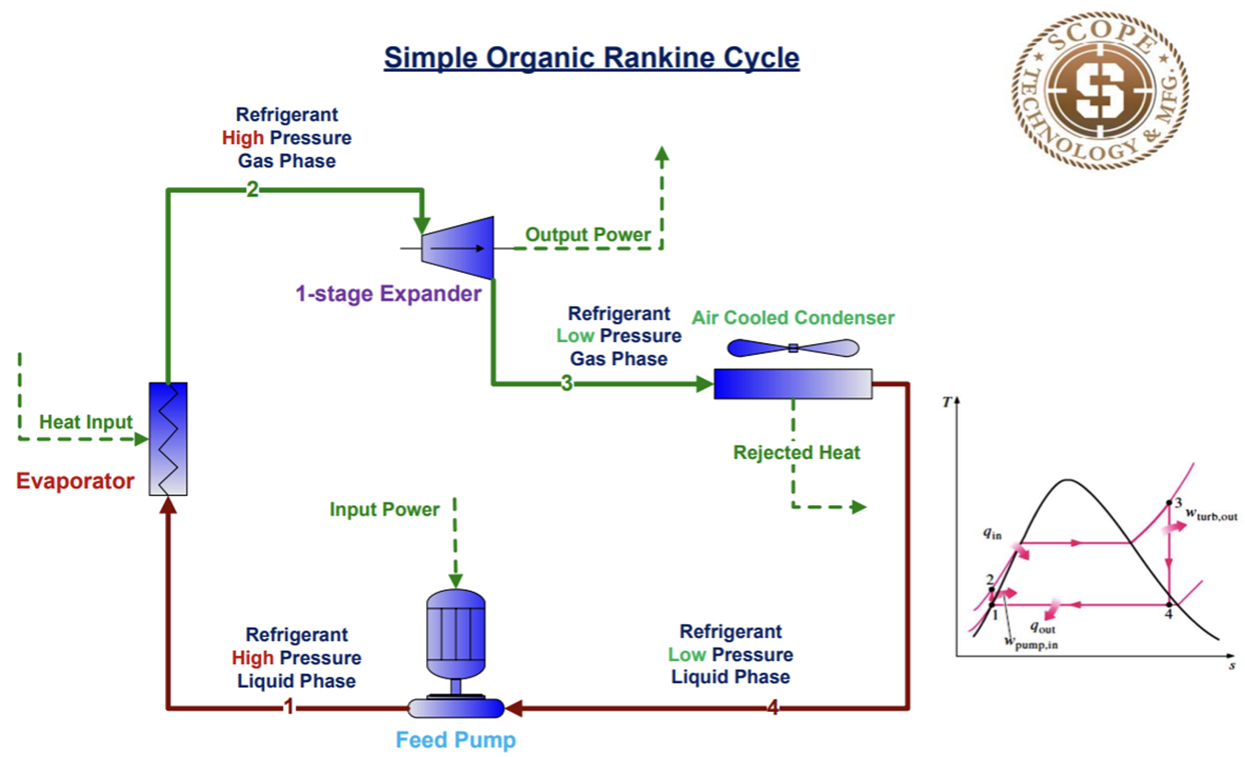
- Waste heat must be treated as a regulatory issue, not a public-relations talking point. Rice University shows that data-center waste heat can be turned into electricity more effectively with solar-boosted ORC systems, while Scope Technology publicly frames waste-heat recovery as a layered engineering and deployment model spanning design, field testing, manufacturing, and heat-to-power integration. [10][11][12][13]
Key Findings at a Glance
| Issue | Why Conservatives Should Care | Baseline Policy Response |
|---|---|---|
| Water | Scarce rural resources should not be transferred to private campuses without transparency and enforceable limits. | Require source-water disclosure, drought plans, and public reporting. |
| Noise & light | Rural landowners should not lose quiet use and dark skies because counties lack urban-style industrial codes. | Set property-line noise caps, shielded lighting, lumen limits, noise absorption/barricades and monitoring. |
| Fire & emergency response | Local taxpayers should not subsidize high-risk industrial response capacity after permits are issued. | Mandate hazard analyses, gas detection disclosures, responder training, and funded local capability. |
| Waste heat | Conservatism is supposed to conserve. Throwing away recoverable energy while demanding more grid buildout is poor stewardship. | Require waste-heat recovery, feasibility studies, equipment and beneficial-use plans where practical. |
Chart 1. U.S. Data Center Electricity Use Is Already on an Industrial Trajectory
▶ CHART 1 PLACEHOLDER — replace this paragraph with an Image block.
Upload the chart titled “U.S. Data Center Electricity Use: Actual and 2028 Projected Range” (2014: 58 · 2023: 176 · 2028 range: 325–580 TWh). Set the image caption to: Source: DOE / Lawrence Berkeley National Laboratory. [1][2]
1. A Conservative Case for Regulation: Stewardship, Property Rights, and No Corporate Free Ride
This paper argues for regulation from a stewardship and local-control standpoint, not from hostility to industry. A conservative position worthy of the name should reject the idea that rural landowners must simply absorb industrial noise, water transfers, emergency-response burdens, and degraded night skies because developers found a county with weaker code. Brookings and WRI both show that rural communities are increasingly carrying the externalities of the data-center boom, while recent Texas moratorium fights show that local governments often discover their legal authority only after projects have already outrun public understanding. [3][4][14][15]
2. The Rural Regulatory Gap Is an Invitation to Exploit Weakness
Developers are not stumbling into unincorporated America by accident. In many states, those areas offer fewer zoning restrictions, fewer lighting controls, and thinner environmental review. National League of Cities and Brookings both describe an environment in which State governments are trying to govern a fast-moving industrial sector with limited staff, limited tools, and compressed timelines. In plain English: nationally strategic infrastructure is being routed through the weakest parts of the regulatory map. [3][6]
3. Water, Noise, and Light Are Real Burdens, Not Cosmetic Complaints
WRI identifies freshwater use as a central community concern, EESI details the chronic noise burden from fans, cooling systems, generators, and turbines, and DarkSky materials explain why artificial light at night; is an environmental and human-health issue rather than a mere aesthetic grievance. Rural communities notice these impacts more intensely because they start from quieter baselines, darker skies, and smaller water systems. [4][5][7]
4. Public Safety Is the Hard Limit Local Officials Cannot Ignore
NFPA and fire-protection sources increasingly emphasize the risks associated with UPS systems, battery chemistries, gas detection, ventilation, and emergency planning in data centers. In many rural counties, volunteer or lightly staffed departments are not equipped for large generator fires, smoke-control operations, or battery-related hazardous events. That means every permit should be understood not merely as a land-use decision, but as an emergency-capacity decision. [8][9][16]
5. Waste Heat Is the Missing Conservative Test
Scope Technology Founder and CEO, wrote a March 18, 2026 Substack article “A world Case for Conservative Environmentalism” explicitly frames the issue as a journey toward “solution-based economies,” which is exactly the right lens for data centers: before asking a community for more land, more water, and more power, operators should be required to prove they are not throwing away recoverable value. Rice University reports that nearly half of data-center energy leaves low-temperature waste heat, and that a solar-boosted ORC configuration can materially improve recovery of economics and output. [10][13]
6. Scope Technology’s Layered Waste-Heat Recovery Approach
Scope Technology & MFG publicly presents waste-heat recovery as a layered engineering model rather than a single gadget sale: accelerated design and modeling, field testing, quality control, manufacturing partnerships, and deployment of heat-to-power systems. Its homepage describes “three focus areas” built on “one thermal stack,” spanning industrial heat, geothermal surface equipment, and digital infrastructure. Scope also highlights a thermal-loop PUE of about 1.09 before AI or DCIM optimization, along with modular ORC efficiency-improvement tools focused on heat exchangers, working fluids, and control systems. In short, the public record describes a practical commercialization pathway for waste-heat recovery, not just an academic possibility. [11][12][17][18]
7. The Political Risk Is Bipartisan Because the Grievance Is Bipartisan
Politico, the Texas Tribune, and KERA have all documented that resistance to data centers is now spreading across Republican and Democratic communities alike. The issue is not party label; it is whether people believe government is willing to protect them when an industry with money and speed collides with a county that has neither. If citizens keep showing up and are told that no standard exists, no tool is available, or no one has authority, then the backlash will move far beyond any single project. [14][15]
Chart 2. Rice University: Waste-Heat Recovery Can Improve Output and Economics
▶ CHART 2 PLACEHOLDER — replace this paragraph with an Image block.
Upload the chart titled “Rice University Findings on Data Center Waste-Heat Recovery.” Set the image caption to: Rice University / related coverage reported 60% more electricity recovery in Ashburn, 80% in Los Angeles, >8% peak ORC efficiency gain, and LCOE reductions of 5.5% and 16.5%. [13][19]
Chart 3. Scope Technology’s CEO Note Highlights Gigawatt-Scale U.S. WHP Potential
▶ CHART 3 PLACEHOLDER — replace this paragraph with an Image block.
Upload the chart titled “Industrial Waste-Heat-to-Power Potential by Sector (as summarized by Scope Technology & MFG).” Set the image caption to: Sector values summarized on Scope Technology & MFG’s waste-heat materials. The same note cites DOE’s estimate that roughly 20%–50% of industrial process energy is lost as waste heat. [12][17]
Conservatism is supposed to conserve. Throwing away recoverable energy while demanding more land, water, and power is not stewardship; it is waste with a lobbyist.
Recommended Policy Position for Commissioners and State Policymakers
- No major data-center sitting in unincorporated rural areas without enhanced review triggered by electrical load, water use, acreage, or on-site backup generation. [3][4][6]
- No incentives, abatements, or fast-track treatment unless the operator discloses source water, cooling technology, backup-power systems, and a hazard-mitigation plan. [4][8][9]
- No approval without a local emergency-response capability assessment and a funded plan for training, equipment, and coordination if current capacity is insufficient. [8][9][16]
- No permanent industrial noise or light trespass imposed on rural residents without enforceable property-line standards and monitoring. [5][7]
- No claims of “advanced infrastructure” without thermal accountability: require waste-heat characterization, feasibility analysis, and recovery or beneficial-use planning where technically practical. [10][11][12][13]
A Fair National Data Center Policy for Rural and Unincorporated Areas
A fair national policy should recognize that rural and unincorporated areas often host large data-center projects without having the same zoning capacity, utility leverage, or negotiating resources as cities. Recent policy analysis emphasizes that these communities are being asked to absorb land-use change, water demand, electric-grid pressure, and public-service costs in exchange for benefits that are often uncertain or unevenly distributed. A national framework should therefore require operators to protect local environmental resources, pay the full public cost of infrastructure and emergency readiness, and guarantee a predictable share of long-term revenue to host jurisdictions rather than relying on opaque incentives or one-time promises that incorrectly balances the scale of the developer from the community of the project lifecycle.
- Require coordinated federal or state reviews for large data centers proposed in rural or unincorporated locations, with explicit thresholds for electric load, water demand, acreage, and backup generation capacity.
- Condition permits and tax preferences on the comprehensive disclosure of projected water consumption, cooling technologies, wastewater impacts, backup power emissions, noise and lighting levels, and fire response requirements. Mandate annual public reporting updates.
- Establish minimum national standards regarding setbacks, shielded lighting, property-line noise limits and absorbtion, stormwater management, drought-response protocols, and decommissioning security to prevent exploitation of less stringent local regulations.
- Mandate cost recovery from operators for incremental public infrastructure needs, including road improvements, expansion of water and wastewater systems, grid interconnection impacts, and emergency response training and equipment.
- Create a host-community revenue rule ensuring a designated portion of project tax value or impact payments benefits counties, school districts, emergency services, and watershed or conservation initiatives within the affected area.
- Encourage community benefit agreements for major campuses so residents receive tangible advantages such as workforce development, enhanced broadband access, habitat restoration, and transparent monitoring of compliance.
- Limit incentives to applicants who meet clear performance standards related to water efficiency, emission mitigation, and local compensation, ensuring that public subsidies result in genuine public benefit rather than speculative commitments.
- Require annual compliance audits and permit renewal reviews to enable communities to verify ongoing delivery of environmental protections and revenue obligations throughout the facility’s operational lifespan.
- Establish abandonment and reclamation funds at the rate of $40.00 per square foot for fixed structures and $5,000.00 per acre for reclamation, maintained in escrow through U.S. Treasury bonds. Should a center be deemed inefficient for next-generation improvements, continued operations, or upgrades, funds shall be disbursed to counties by the Department of Interior within 60 days after cessation of operations.
Conclusion
The strongest case for regulating data centers in rural America is not anti-business. It is a simple demand for adult supervision. If the nation wants AI infrastructure, then it needs laws of cohesive rules worthy of the scale, risk, and resource appetite of that infrastructure. Counties should not be forced to trade away quiet use, water security, night skies, and emergency-service margins simply because developers move faster than counties can adopt code. A national industry requires national rules—and a serious conservative movement should be first in line to insist on them. [1][3][4][14][15]
References and Source Notes
- [1] U.S. Department of Energy. “DOE Releases New Report Evaluating Increase in Electricity Demand from Data Centers.” Dec. 20, 2024. energy.gov
- [2] Lawrence Berkeley National Laboratory. “2024 United States Data Center Energy Usage Report.” Dec. 2024. eta-publications.lbl.gov
- [3] Brookings. “The local implications of data centers for rural communities in the US.” Mar. 2, 2026. brookings.edu
- [4] World Resources Institute. “7 Ways Data Centers Affect U.S. Communities.” Feb. 17, 2026. wri.org
- [5] Environmental and Energy Study Institute. “Communities Are Raising Noise Pollution Concerns About Data Centers.” Mar. 23, 2026. eesi.org
- [6] National League of Cities. “Data Centers and Local Environmental Considerations.” May 23, 2025. nlc.org
- [7] DarkSky International / DarkSky Texas. Research and policy resources on artificial light at night and Texas outdoor lighting authority. darksky.org
- [8] NFPA Journal. “The Lithium-Ion Battery Risk Inside AI Data Centers.” Feb. 11, 2026. nfpa.org
- [9] Consulting-Specifying Engineer. “Fire protection systems to ensure safety for data centers.” May 22, 2025. csemag.com
- [10] Chris’s Substack archive. Entry for “A world Case for Conservative Environmentalism” (Mar. 18, 2026), subtitle: “My Journey toward solution-based economies.” cmk9232.substack.com
- [11] Scope Technology & MFG homepage. “Heat Has to Go Somewhere. We Make It Go to Work.” Accessed May, 2026. scopemfg.com
- [12] Scope Technology & MFG. “Heat to Power” / ORC modules and waste-heat materials. Accessed May, 2026. scopemfg.com/tag/heat-to-power
- [13] Rice University. “Rice researchers turn wasted data center heat into clean power.” Sept. 3, 2025. news.rice.edu
- [14] Politico. “Texas county passes 1-year data center construction ban.” May 16, 2026. politico.com
- [15] Texas Tribune / KERA. Coverage of Hill County and Hood County data-center moratorium disputes, Feb.–May 2026. texastribune.org
- [16] INTEC Controls. “Data Center Gas Detection | Hydrogen & Battery Room Safety.” Accessed May, 2026. inteccontrols.com
- [17] Scope Technology & MFG. “Waste Heat Archives” CEO note on industrial waste-heat-to-power potential. Accessed May, 2026. scopemfg.com/tag/waste-heat
- [18] Scope Technology & MFG. “Waste Heat Recovery.” Accessed May 26, 2026. scopemfg.com/new-technology
- [19] Data Center Dynamics. “New study explores potential of converting data center waste heat into a power source.” Sept. 5, 2025. datacenterdynamics.com